
alannah.oleson at du.edu
Assistant Professor
Computer Science
University of Denver
I research socially responsible HCI and AI education. I pursue equitable and liberatory technology futures by exploring novel ways to teach and learn the principles of inclusive, accessible, critical, and ethical technology design. My interdisciplinary work draws upon ideas from many fields, including human-computer interaction (HCI), computing education research, justice-centered design theory & methods, accessibility & disability justice, information science, critical data studies, teacher knowledge, and software engineering. I partner with communities to do this work, identifying challenges they face and evaluating potential solutions together. I usually employ qualitative and design research methods to deeply explore these contexts and the experiences of the people within them.
I am an Assistant Professor in Computer Science at the Ritchie School of Engineering and Computer Science at the University of Denver. Previously, I worked with Amy J. Ko at the University of Washington Information School for my doctoral studies and Margaret M. Burnett at Oregon State University CS for my undergraduate research.
I am not currently recruiting students for my lab, but may be in future cycles.
News & Talks
Oct 2026: I am a Mozilla Responsible Computing Challenge Fellow! Our two-year project, "CHAI: Career-ready Humanities-based AI Education Modules" will explore how to integrate critical AI literacy into humanities and social science education across a range of settings, including formal, informal, and community-based learning environments. We're partnering with faculty from Gender & Women's Studies, Japanese Studies, and Public Policy to make it happen.
Aug 2026: I've been awarded a three-year National Science Foundation IUSE grant titled "Multisite Comparison of Embedding Socially Responsible Design Across the Undergraduate Computer Science Curriculum!" Together with collaborators at three other institutions, we will integrate socially responsible design (SRD) into four-year CS curricula to help teach students how to build software that benefits everyone.
Feb 2026: I'll be at the SIGCSE Technical Symposium to present two items: One on ethics integration in CS0 courses, and a special session on teaching accessibility in CS. Reach out if you are be attending the conference and want to connect!
Aug 2025: With DU colleague Laurel Taylor, I presented my recent paper Design as Translation, Translation as Design: Toward Critical, Creative, and Ethical Pedagogies at the 2025 EduCHI Symposium in Bloomington, Indiana! Read an overview of the event from the hosting Luddy School of Informatics here.
July 2025: I will be at the 2025 ACM RESPECT conference as a discussant for the doctoral consortium! Say hello :)
April 2025: I was invited to speak at the ATLAS Colloquium at CU Boulder! I gave a talk titled Toward Critical, Ethical, Reflective, and Creative HCI Education Futures.
Jan 2025: In collaboration with AiiCE, I moderated a panel with authors from our Teaching Acessible Computing book, an ongoing project to help computing educators develop content knowledge in accessibility topics.
Nov 2024: I joined the editorial board of ACM Transactions on Computing Education as an Associate Editor for HCI education and critical computing research.
Sept 2024: Started at the University of Denver as an Assistant Professor in CS. If you're in the Denver area or interested in collaborating, please reach out!
March 2024: The first edition of Teaching Accessible Computing is out! It contains 16 chapters on how to integrate accessibility topics into CS courses.
Dec 2023: Successfully defended my dissertation Integrating Inclusive Design and Computing Education! I'll spend the next few months wrapping up projects as a postdoc at the Center for Learning, Computing, and Imagination.
Research
Lab
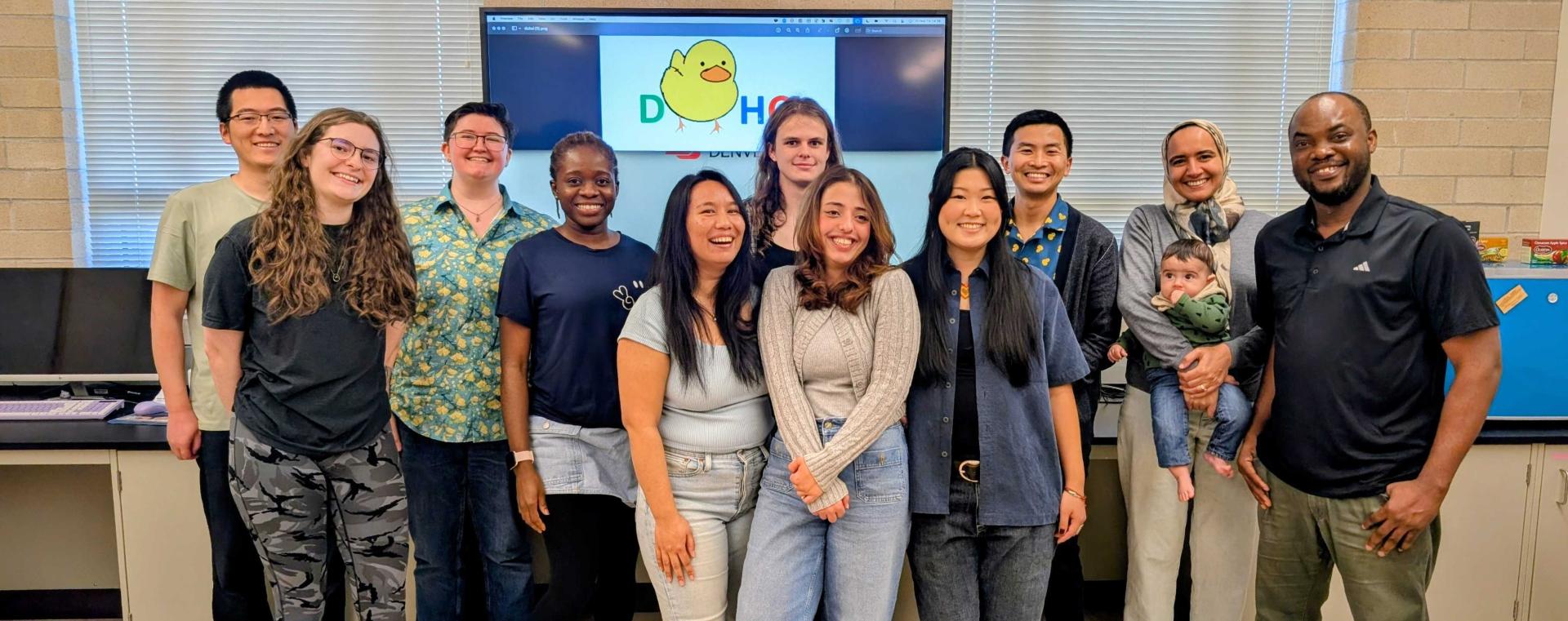
I lead the TEACUP lab at the University of Denver (Lab website coming soon). We conduct research around Teaching Empathy, Agency, and Criticality for Unlearning Power in computing education. We are affiliated with the broader DUHCI research group.
Current Research Interests
Teacher Knowledge for Ethics, Inclusive Design, and Accessibility
What knowledge do CS educators need to teach topics like accessibility, ethics, and inclusive design effectively?
I work with communities of educators to document the pedagogical content knowledge they develop as they engage with new critical CS topics. Together, we co-design and evaluate activities in authentic CS learning contexts through participatory action research, resulting in shareable teaching resources. This work is supported by AccessComputing and the NSF.
CS Student Learning Challenges around Critical Tech Design
What makes learning about ethics and inclusive design so uniquely difficult for many CS students?
I develop and evaluate pedagogical methods for teaching accessiblity concepts, inclusive design, and critical & ethical thinking in computing learning contexts. I ground these methods in formative research about student learning challenges including interviews and surveys with current and prior students. This work was previously supported by the NSF (Graduate Research Fellowship).
Responsible AI Competencies in the Humanities & Social Sciences (HSS)
What should humanities & social science students learn so they can responsibly use AI tools in their future careers?
For better or for worse, artificial intelligence (AI) tools are transforming the competencies all students need to succeed in their future careers. With HSS faculty partners, I explore how students beyond STEM can learn to responsibly wield AI technologies in discipline-specific ways. This work is supported by the Mozilla Foundation's Responsible Computing Challenge.
Developing CS Students' Senses of Ethical Agency
How can we empower CS students to confidently act upon their ethical knowledge?
Even when CS students are taught about ethics in their coursework, they don't always know how to translate it into practice. I explore how computing education norms and practices support or detract from students' self-efficacy to create ethical technology, with the goal of developing a validated instrument for measuring ethical agency. This work is a joint effort with researchers from the Universty of Glasgow and Uppsala University and is supported by Research Innovation Scotland's International Collaboration Fund.
Other Interests
Here is a grab bag of other topics I'm interested in, though they aren't at the forefront of my research right now:- Community-based Design Justice work
- Resisting techno-nihilism and integrating harm reduction in CS education
- Algorithmic bias and fairness, especially in data schemas and demographic data
- Queering design and education norms for hopeful, liberatory technologies and classrooms
Publications
Below are a few publications I'm particularly proud of. For a full list of my papers, refer to my publications page.
Design as Translation, Translation as Design: Toward Critical, Creative, and Ethical Pedagogies
Alannah Oleson, Laurel Taylor (2025)
EduCHI Symposium on Human-Computer Interaction Education
[ACM DL Link]
Teaching Inclusive Design Skills with the CIDER Assumption Elicitation Technique
Alannah Oleson, Meron Solomon, Christopher Perdriau, Amy J. Ko (2023)
ACM Transactions on Computer-Human Interaction (TOCHI)
[ACM DL Link] [Blog Post Summary]
🏆 Best Paper Award
Funds of Knowledge used by Adolescents of Color in Scaffolded Sensemaking around Algorithmic Fairness
Jean Salac, Alannah Oleson, Lena Armstrong, Audrey Le Meur, Amy J. Ko (2023)
ACM International Computing Education Research Conference (ICER)
[ACM DL Link]
A Decade of Demographics in Computing Education Research: A Critical Review of Trends in Collection, Reporting, and Use
Alannah Oleson*, Benjamin Xie*, Jean Salac, Jayne Everson, F. Megumi Kivuva, Amy J. Ko (2022)
ACM International Computing Education Research Conference (ICER)
[ACM DL Link]
🏆 Best Paper Award for Diversity & Inclusion Contributions
Surfacing Equity Issues in Large Computing Courses with Peer-Ranked, Demographically-Labeled Student Feedback
Benjamin Xie, Alannah Oleson, Jayne Everson, Amy J. Ko (2022)
Proceedings of the ACM on Human-Computer Interaction (PACMHCI), presented at ACM Computer-Supported Collaborative Work (CSCW)
[ACM DL Link]
Books
I have edited or authored chapters in a few online textbooks. Unlike print books, these are free, digital, searchable, interactive, and web-accessible resources. These are living documents that lower barriers to accessing knowledge and best practices within computing education. I plan to continue developing and refining resources like these throughout my academic career.
Teaching Accessible Computing

Critically Conscious Computing: Methods for Secondary Education

Teaching
These are the courses I teach. Courses I'm actively teaching or developing are closer to the top of the list. If you're interested in materials or curriculum design tips for these topics, please reach out.
Design Justice
University of Denver COMP 3701 | Last taught Spring 2026; planned Spring 2027
New course, original curriculum design. Seminar. Students read about, discuss, and reflect upon what “justice” means in the context of today’s technological landscape from different theoretical perspectives (e.g. disability justice, anti-racist design), articulating and refining their values and commitments as tomorrow’s technology practitioners.
User Experience Design Methods
University of Denver COMP 3705 | Last taught Winter 2026; planned Winter 2027
New course, original curriculum design. Flipped classroom. Introduces students to the basic methods needed to succeed in UX design careers, such as problem framing, ideation methods, low- and mid-fidelity prototyping, design evaluation methods, and synthesis of user research. Students deeply explore a design problem of interest from multiple perspectives and present a design specification at the end of the term.
Human-Computer Interaction
University of Denver COMP 3/4100 | Last taught Fall 2025
Redesigned an introductory HCI/UX design course (elective for graduates & undergraduates) to integrate active learning and discussion activities in every class session, based on effective HCI education research. Students learn basic HCI principles and design methods through digital prototyping, then build collaboration skills through a final design team project to address a structural inequity around campus.
Intro to Computer Science I
University of Denver COMP 1201 | Last taught Fall 2024
Designed and implemented an introductory CS course (required for majors/minors, open to all) on algorithmic thinking, career readiness, and ethical perspectives on technology. Students engage in activities and discussions to build CS foundations and identities.
User-Centered Design Methods
University of Washington INFO 360 | Last taught Spring 2020
This undergraduate class teaches students design thinking skills in the domain of information and computing. It leverages multiple forms of active learning, involves a significant amount of studio-based learning, and helps students develop creative confidence.
Cooperative Software Development
University of Washington INFO 442 | Last taught Fall 2020
This undergraduate software engineering class teaches foundations of team-based software development, leveraging the latest research on coordination, cooperation, and human cognition in software development. Students leave ready to become meaningful contributors to teams big and small, but also to understand the processes that teams use and how they can improve them.
Communities
I work with these communities to research, advocate, and impact the world beyond academia.
Mozilla Responsible Computing Challenge (2026 Cohort)

EduCHI Community of Practice

AccessComputing

DUB

ComputingEd@UW

EUSES Consortium

OSU STEM Leaders Program

Awards & Honors
I've recieved several awards for various contributions to my communities.

Faculty Career Champion Award (2026)
Awarded by student nomination & career council review to a faculty member who has gone above and beyond to support students’ career, internship, and post-graduation goals.
Excellence in Undergraduate Mentoring Award (2025)
University of Denver Dean's Award (2025)
Awarded in first year of assistant professorship for significant contributions to the school’s research goals, teaching & mentorship programs, and service to the DU community.

University of Washington Husky 100 (2022)
Awarded annually to 100 of UW’s 60,000 students who make exceptional contributions to research, teaching, mentorship, and service to the institution. Highest honor available for students.

NSF Graduate Research Fellowship (2018-2023)
Recognizes and supports outstanding graduate students in National Science Foundation-supported science, technology, engineering, and mathematics disciplines.

CRA Outstanding Undergraduate Researcher, Finalist (2018)
Recognizes undergraduate students in North American colleges and universities who show outstanding research potential in an area of computing research.

Adobe Research Women-in-Technology Scholar (2017)
Recognizes outstanding undergraduate and masters students anywhere in the world who study computer science. Led into to an internship at Adobe Research with Cynthia Lu, Jose Echevarria, and Radomir Mech.
Contact Me
Office Hours (ECS 371)
If you are a current DU student enrolled in one of my courses, see the syllabus for office hours information. If you are a DU student but not currently enrolled in my courses, or if you are not a DU student, contact me via email and we will meet if appropriate.
My office is in the Engineering and Computer Science building on the 3rd floor, room 371.
My institutional email is alannah.oleson@du.edu. Email is the best way to reach me in many cases. To maintain work-life boundaries, I typically do not check my email on weekends or holidays.
CV
The most current version of my CV can be found at this link: October 2026 CV (pdf)
Online profiles
- Google Scholar
- Medium: @OAlannah
- LinkedIn: aoleson
- GitHub: aoleson